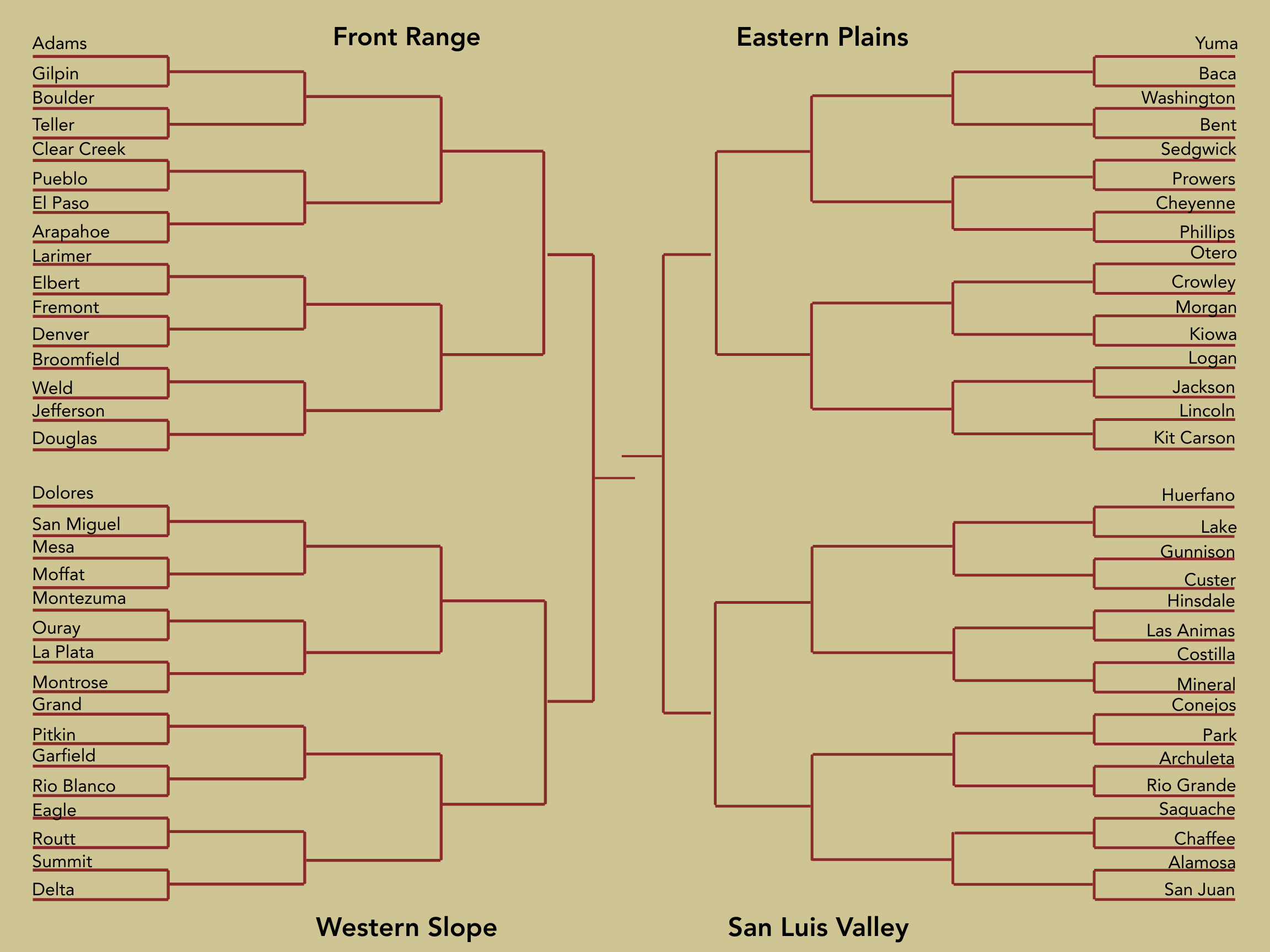
Follow along with the Colorado County March Madness Challenge and learn about Colorado’s 64 counties! Find a deeper history of each county from the Colorado Encyclopedia here.
Make sure to follow along and vote for your favorite iconic locations on Instagram.
Regions
Standings as of March 19, 2026:
San Luis Valley
Alamosa: Great Sand Dunes
Alamasoa County (Est. 1913), originally named for the spanish word “cottonwood grove” is located in a valley bordered by the Sangre de Cristo Mountains on the east and the San Juan Mountains to the west. The town of Alamosa was built, along with the Denver & Rio Grande Western Railroad, and brought almost 100 buildings on flatbed cars and hauled to the valley to be set up along the railroad’s new terminal. Alamosa became a regional hub, and eventually its own county. The Sand Dunes, while thousands of years old, became a protected national monument in 1932 in order to stop gold mining and sand extraction for cement. Tribes like the Ute and Apache consider them sacred “breathing” mountains. Boettcher has recently partnered with several nonprofits such as Care and Share in Alamosa to fund local food access and community infrastructure projects.
Archuleta: Chimney Rock National Monument Dark Sky Park
Archuleta County (Est. 1885) was named after Antonio D. Archuleta, a well known Spanish pioneer and state senator from Conejos county, but is most known for its deep Ute Indigenous tribe roots, and the geothermal ‘healing waters’ of Pagosa Springs. Chimney Rock is an outpost of the Chacoan culture famous for the “Lunar Standstill” where every 18.6 years, the moon rises perfectly between the two rock formations. The Puebloans who originally inhabited this area used this phenomenon for their calendar. The monument became Colorado’s 19th certified International Dark Sky Park in December of 2025, joining a growing list of places dedicated to dark sky conservation and education.
Chaffee: St. Elmo Ghost Town
Chaffee County (Est. 1879) is named for Jerome B. Chaffee, one of Colorado’s first Senators. Trading and trapping began early in the 19th century in this area, but was considered dangerous up until the start of the Colorado Gold Rush. With the establishment of the Colorado Territory in 1861 and the influx of prospectors, present-day Chaffee County became a part of Lake County until its eventual split in 1879. Home to many of Colorado’s most popular mountain towns, like Buena Vista, the county is a hub for outdoor adventure seekers, but is also home to historical sites like St. Elmo, one of the most well maintained ghost towns in Colorado. The Mary Murphy Mine resided here, bringing in over 30 tons of ore per day; however, when the railroad stop closed in 1922, the town stopped growing along with it.
Conejos: Cumbres & Toltec Scenic Railroad
Conejos County (Est. 1861) is one the 17 original counties in Colorado. Originally a northern territory of Mexico, this county was inhabited mostly by New Mexican settlers, many of whom were granted US Citizenship after the Mexican American War. The cultures and traditions of these settlers heavily influenced this area, with Spanish Colonial style homes and the first Catholic church in the state. The Cumbres & Toltec Scenic Railroad is a narrow-gauge historic railroad built in 1880 as part of the Denver & Rio Grande Western Railroad extension to serve silver mining. It is now a National Historic Landmark, recognized as one the longest and highest steam railroads in North America.
Costilla: Historic San Luis
Costilla County (Est. 1861) is another original county, named after the Costilla River. Much like Conejos, the county was home to mostly settlers from New Mexico and those granted citizenship after the war. Established in 1851, San Luis is the Costilla county seat and the oldest continuously occupied town in Colorado. In 1857 the local R&R Supermarket was built, and is known as the oldest continuously operating business in Colorado. The Town of San Luis is prioritizing planning a community center and was recently awarded a Rural Catalyst Grant to support this process.
Custer: Bishop’s Castle
Custer County (Est. 1877) named after George Armstrong Custer shortly after the Battle of Little Bighorn. Originally there was a rush for the copper and silver in Rosita, but was quickly overshadowed by the silver strikes in Silver Cliff, which became the third largest city in Colorado by 1880 and held the county seat for 42 years until it moved to Westcliffe in 1928. Eventually, when the mining declined, the D&RG railroad fueled growth in the agricultural area and Custer is still known for its rural, ranching culture. Bishop Castle, located in Rye, is a hand built stone and iron castle created solely by Jim Bishop. Originally intending it to be a family cabin, Bishop bought the land at age 15 and started construction in 1969. He continued to work on it for over 40 years after a neighbor joked the stine walls looked like a turret, inspiring him to build a castle. It is now a roadside attraction that is free to the public, but still has its grand ball room and stained glass windows that make it so distinguishable.
Gunnison: Blue Mesa
Gunnison County (Est. 1877) is named for the explorer who first surveyed the area for a transcontinental railroad route, John. W Gunnison, in 1853. Many of the towns in the territory became Ghost Towns after the silver boom faded, but the cattle and sheep ranching provided stability for the town of Gunnison and its surrounding neighbors. While still a ranching community at its core, the county is a popular destination for skiing and winter activities, as well as a college hub after the opening of the State Normal School (now Western Colorado University) in 1911, the first college on the Western Slope. As part of the Colorado River Storage Project, a 390-foot dam was put on the Gunnison river a few miles before it entered the Black Canyon. The project’s goal was to build and place dams and reservoirs that would store and regulate the flow of the Colorado River. In addition to the achievement of regulating the river, Blue Mesa lake now heavily contributes to Gunnison County’s expanding tourism industry by becoming a hotspot for boating, fishing and camping.
Hinsdale: Alpine Loop Scenic Byway
Hinsdale County (Est. 1874) is one of the most remote counties in Colorado, with a population of around 750 people. Originally a traditional hunting ground for Ute tribes, it was silver and gold that brought people to this remote area. The county seat, Lake City, is one of the largest historic districts from the mining area due to telephone service that linked it to Silverton and Ouray. The alpine is a 63 mile route that connects mining towns across the passes. The route requires a 4WD vehicle and is only open from June to September, due to their efforts to preserve its rugged historic character. Hinsdale County recently built Slumgullion Observatory, supported by Boettcher in 2021, which is allowing them to expand opportunities for tourism as an International Dark-Sky Association Designated Park.
Huerfano: Spanish Peaks
Huerfano County (Est. 1861) is another of the original 17 counties, named for the solitary Huerfano Butte (Spanish for orphan), a lone volcanic plug in the plains. Unlike many of its neighboring counties, Huerfano was known for its coal mining boom and not silver or gold. Walsenburg was once dubbed “The City Built on Coal.” The Spanish Peaks are two prominent volcanic mountains with deep history as sacred landmarks to indigenous tribes, and critical guides for travelers along the Santa Fe Trail.
Lake: Tabor Opera House
Lake County (Est. 1861) sits high in central Colorado where alpine basins and glaciated peaks feed the headwaters of the Arkansas River. The county’s story is rooted in the late-19th-century mining boom centered on Leadville, whose silver and mineral strikes sent waves of prospectors into the surrounding mountains and created one of Colorado’s most intense mining districts. After the mining booms eased, Leadville’s preserved Victorian streets and nearby wilderness drew visitors, while ranching and outdoor recreation helped stabilize the local economy. Indigenous Ute peoples used high mountain valleys seasonally long before Euro-American mining and settlement transformed the landscape. The Tabor Opera House in Leadville, built by silver magnate Horace Tabor, stands as a restored 19th-century cultural landmark—originally a venue for theater, dances and public gatherings during the town’s boom years and now a focal point for historic interpretation and events. The Boettcher family made it rich in Leadville; Charles Boettcher set up a hardware business in downtown Leadville to supply miners with tools and equipment, but his business interests soon expanded to the mining industry itself. He often accepted mining shares or real estate as payment for goods and during the 1880s, Charles acquired many mining properties as well as several profitable real estate properties in Leadville. He was also instrumental in bringing electricity to Leadville by financing the Leadville Electric Light Company.
Las Animas: Baca House
Las Animas County (Est. 1866) is Colorado’s largest county by area. The name comes from the Purgatoire River, originally named in the Spanish El Rio de las Animas Perdidas en Purgatorio (River of the Lost Souls in Purgatory.) By 1910, it was Colorado’s fourth most populous county, driven by coal mining that led to the eventual violent coal strikes where about 1200 workers striked, and ultimately failed to shut down the industry. The Baca House was built in 1870 by a merchant, and was popular due to its unique features like the “widows walk” and two story structure. Felipe Baca and his wife, Dolores traded 22,000 pounds of wool for this house and lived there for 60 years. Felipe Baca went on to play a big role in the statehood of Colorado, and was a leading voice in having the Colorado Constitution written in Spanish as well as English, ensuring the integration of the Spanish-speaking community into the state. In 2025, Las Animas County was awarded a Rural Catalyst Grant to facilitate a community survey to enhance outreach to immigrant and underserved populations.
Mineral: Creede Repertory Theatre
Mineral County (Est. 1893) was created because of the massive silver strike in Creede, which remains its only town. After the boom, all of the other sites outside of Creede did not survive, and there was an economic shift in Creede from mining to racing and tourism. Over 90% of the county is covered by the Rio Grande National Forest, and much of the history of the mining areas has been preserved. The Creede Repertory Theatre is a non-profit company founded in 1966 that has served as a major cultural center in the midst of the remote mining town, bringing high end theatre to the San Juan Mountains. Boettcher partnered with the Creede Repertory Theatre in 2017 to support renovations.
Park: Burro Days
Park County (Est. 1861) is one of Colorado’s original counties, shaped by the Pikes Peak Gold Rush. Centered in the South Park grassland valley, which was dubbed “The Park” by early fur trappers and mountain men. In 1948 the first World Championship Pack Burro Race was held in Fairplay. Burro Days, an annual festival held the last weekend of July, sends runners twenty-nine miles to the top of Mosiquito Pass and back with a burro.
Rio Grande: Sandhill Cranes at Monte Vista Wildlife Refuge
Rio Grande (Est. 1874) follows the same mining to agricultural community as many in this area and is named after the river that provides the water source for all of the region’s development. In the early twentieth century, the county was heavily focused on improving rural education and established a comprehensive school plant to serve a 100- square-mile rural area. The district was solidified, following the national trends of standardization of education early on. The Sandhill Cranes at Monte Vista Wildlife Refuge was established in 1952, providing essential wetlands and barley fields where the cranes rest, feed and perform mating dances before continuing onto northern breeding grounds. Up to 27,000 cranes stop here each spring and fall, a migration tradition that has spanned thousands of years. Boettcher has been involved in the area since 1954 with the first Boettcher Scholarship in this county granted to Edith Collins of Monte Vista.
Saguache: Crestone Peak
Saguache County (Est. 1886) takes its name from a Ute word meaning “blue earth.” The valley floor became a center for high-altitude agriculture and sheep ranching, with the eastern edge defined by the jagged Sangre de Cristo Range. In more recent years, this area has become a global center for spirituality, hosting Buddhist stupas, Hindu temples and Carmelite monasteries, all drawn to the sacred energy the Ute people recognized centuries ago. Crestone Peak stands as one of Colorado’s most challenging fourteeners, involving nearly 6,000 ft of elevation gain.
San Juan: Million Dollar Highway
San Juan County (Est. 1876) is the highest county in the United States, with an average elevation of 11,240 feet. Following the Brunot Agreement, a negotiation for the development of mining in the San Juan Mountains between the Ute tribes and US Government, San Juan County was created along with the silver boom in Silverton. The Million Dollar Highway is a beautiful section of U.S 550 that was originally a toll road in the 1880’s by “Pathfinder of the San Juan” Otto Mears to move between Silverton and Ouray. Legends vary on the name, with some saying it cost a million dollars a mile to build, while others claim the fill dirt contains a million dollars in gold ore. It remains one of the most scenic drives in the world, preserved as part of the San Juan Skyway.
Eastern Plains
Baca: Carrizo Canyon
Baca County (Est. 1889) occupies the southeastern corner of the state, named after Spanish pioneer Felipe Baca. During the Dust Bowl in the 1930s, extreme drought, wind and dust erased many towns. In the wake of the Dust Bowl, the county was a hotspot for soil and water conservation efforts and formation of soil conservation districts. In the midst of this unforgiving high-plains environment sits the Carrizo Canyon, a canyon that served as a travel corridor, providing water and shelter to Indigenous peoples, including the Plains Apache and Comanche, living, hunting and moving in this area. The canyon contains ancient rock art and petroglyphs from this time.
Bent: Boggsville Historic Site
Bent County (Est. 1870) lies on Colorado’s southeastern plains along the Arkansas River and the historic Santa Fe Trail, and takes its name from trader William Bent whose Bent’s Fort was a major early-19th-century trading post in the region. The county’s history moves from Indigenous trade and diplomacy (Cheyenne and Arapaho) through the fur trade into ranching and irrigated agriculture as rail and river access opened the plains to settlers. Frontier-era ranching and Santa Fe Trail heritage have shaped small towns and preserved sites across the county. Today Bent balances agricultural landscapes with interpretation of its frontier past. Boggsville Historic Site near Las Animas preserves adobe structures and a 19th-century farmstead that illustrate frontier cross-cultural life and the region’s role on the Santa Fe Trail.
Cheyenne: Kit Carson Museum
Cheyenne County (Est. 1889) sits on Colorado’s eastern High Plains and was the home of the allied Cheyenne and Arapaho peoples, and was later developed as a ranching and agricultural landscape after rail lines and homesteaders settled in the region in the late 19th century. The county’s settlement and economy were shaped by cattle ranching, dryland farming and periodic droughts — including the Dust Bowl era — while small towns grew as service centers for surrounding farms.The Kit Carson Museum preserves local pioneer and ranching artifacts and interprets Cheyenne County’s agricultural, railroad and civic history.
Crowley: Lake Meredith
Crowley County (Est. 1911) was one of the last counties formed in Colorado, split from Otero. The county area was once the hunting and wintering ground of many native peoples, including the Kiowa, Cheyenne, and Arapaho. It was envisioned to be an agriculture paradise powered by an irrigation system that tapped into the Arkansas River. In 1935 the Twin Lakes Reservoir and Canal Company completed a $2 million trans-mountain diversion system that carried water from the west side of the Continental Divide, near the town of Twin Lakes, to the Arkansas River. The new water source kept Crowley County farms producing until the 1970s. Lake Meredith now offers camping, boating, and fishing.
Jackson: State Forest State Park
Jackson County (Est. 1909) is geographically unique, encompassing the high mountain basin known as North Park. This area was central to a local logging boom, and logging operations for the state. State Forest State Park, the largest in Colorado’s system, is known as the Moose Capital of Colorado. The reintroduction of Moose here in the 1970’s was so successful that there is now a thriving population across the state. The park preserves the land Colorado is so famous for- jagged peaks, hidden lakes and dense forest.
Kiowa: Kiowa County Courthouse
Kiowa County (Est. 1889) bears a heavy historical weight, being the site of the San Creek massacre 1864, a defining tragedy in Colorado’s relationship with the Cheyenne and Arapaho peoples. The arrival of the Missouri Pacific Railroad in the late 1880s spurred the growth of towns like Eads (the county seat) and helped build the economy on cattle ranching and farming, overcoming the severe drought cycles. The Kiowa County Courthouse was built in Eads in the early 20th century after the first was destroyed in a fire. It is a beautiful two story red brick courthouse that stands today after surviving the Dust Bowl, acting as a symbol of resilience.
Kit Carson: Kit Carson Carousel
Kit Carson County (Est. 1889) is named after the famous scout and trapper who led John C. Fremont through the Rocky Mountains. It became a key part of the High-Plains wheat growing region, contributing heaving to the golden belt of production pushed by WW1 demand. An iconic treasure is the Kit Carson County Carousel, a fully restored 1905 creation. It is one of the few remaining antique carousels in the country that has original paint on the hand carved animals.
Lincoln: Wonder Town in Genoa
Lincoln County (Est. 1889) followed the path of the Smoky Hill Trail, a dangerous pioneer route to the gold fields, and is named after President Abraham Lincoln. The economy like many others in this area was built on farming, livestock and racing. While Hugo is the county seat, Genoa hosts the Wonder Tower, a roadside attraction built in the 1920’s. In response to the automobile tourism of the era, the tower claimed that on a clear day, one could see six states from the top.
Logan: Historic Sterling
Logan County (Est. 1887) occupies a swath of northeastern Colorado prairie and developed as part of the late-19th-century settlement of the high plains, where rail lines and irrigation fostered wheat farming and cattle ranching. Named for General John A. Logan, the county’s towns and civic institutions grew as homesteaders established farms and grain elevators; periodic droughts and the Dust Bowl era shaped local agriculture and community responses. The area lies within traditional Cheyenne and Arapaho lands and reflects layered Plains history from Indigenous use to Euro-American agricultural settlement. The historic Sterling courthouse and downtown reflect Logan County’s growth as an agricultural service center—Sterling became a focal point for grain trade, county governance and regional fairs.
Morgan: The Great Western Sugar Company
Morgan County (Est. 1889) originated as a military outpost protecting the Overland Trail. In the 1900’s it was transformed by the “White Gold” of the era; sugar beets. The Great Western Sugar Company in Fort Morgan became the economic backbone of this region, bringing in a large workforce. The mix between industrial and agriculture shaped the county into a productive landscape or irrigation canals and factory smokestacks.
Otero County: Bents Old Fort
Otero County (Est. 1889) occupies southeastern Colorado’s plains along the Arkansas River and the Santa Fe Trail corridor. Named for Miguel Antonio Otero, the county developed as an agricultural and transportation hub after railroad connections and irrigation opened the valley to markets; ranching and farming anchored its economy. The area’s frontier history is closely tied to overland trade and Indigenous diplomacy, with Cheyenne and Arapaho nations shaping a long pre-contact and post-contact presence in the plains. Otero’s landscape preserves ties to Santa Fe Trail history and frontier trading posts. Bent’s Old Fort, near La Junta, is a reconstructed 19th-century adobe trading post that served as a major meeting place for Plains tribes, trappers and traders on the Santa Fe Trail and today interprets that trade and diplomatic history for visitors.
Phillips: Philips County Museum
Phillips County (Est. 1889) lies on Colorado’s northeastern plains, a broad agricultural landscape shaped by farming, cattle ranching and late-19th-century settlement. Prior to Euro-American settlement the area was used by Plains tribes. The county’s towns grew with railroad arrival and homesteading; small civic institutions, fairs and community cooperatives helped sustain rural life through boom-and-bust cycles. Farming and ranching traditions continue to define Phillips County’s economy and identity. The Phillips County Museum preserves local agricultural artifacts, early town histories and exhibits that interpret settlement, ranching and community life on the northeastern plains. Boettcher supported Phillips County in 2019 to help construct a pavilion and education center at the county fairgrounds in Holyoke.
Prowers: Santa Fe Trail Scenic and Historic Byway
Prowers County (Est. 1889) occupies southeastern Colorado along the Arkansas River and the historic Santa Fe trade routes, with a history tied to ranching, trade and cross-cultural exchange. Named for John W. Prowers, a prominent rancher and entrepreneur, the county’s towns served as trading and service centers for agricultural producers and travelers on 19th-century transportation corridors. The county sits on lands long used by Plains tribes and later by Hispanic and Anglo settlers whose ranching and farming shaped the region’s cultural landscape. The Santa Fe Trail Scenic and Historic Byway passes through Prowers County and highlights the county’s connection to historic trade routes, frontier crossings and early overland transportation.
Sedgwick: Pony Express
Sedgwick County (Est. 1889) sits on Colorado’s far northeastern plains near the Nebraska line and has an agricultural history built on dryland farming and cattle ranching following late-19th-century settlement. Named for General John Sedgwick, the county’s towns and grain economies developed with the arrival of rail, and its open plains were historically part of Plains Indian hunting grounds prior to Euro-American homesteading. Transportation and postal routes, including early stage and express lines, shaped Sedgwick’s role as a frontier service area. Local Pony Express and stage-route sites in the county recall Sedgwick’s role in overland communication and travel, linking small towns and ranches to regional markets during the frontier period. In 2016, Boettcher supported Sedgwick County in their renovations of the Julesburg depot for a museum and historic byway trailhead center.
Washington: Eastern Colorado Roundup
Washington County (Est. 1887) occupies the central eastern plains of Colorado and developed into a productive farming and ranching county during the late 19th and early 20th centuries. The county’s economy centers on dryland and irrigated agriculture, and small towns emerged as service centers for surrounding farms; Plains tribes used the area seasonally before homesteading closed the frontier. County fairs, livestock shows and roundup traditions remain focal points of civic life and rural identity. The Eastern Colorado Roundup and similar county fairs celebrate Washington County’s agricultural heritage, bringing together ranchers, farmers and communities for livestock exhibitions and rodeo traditions.
Yuma: Wray Lions Amphitheatre
Yuma County (Est. 1889) occupies Colorado’s northeastern corner where broad prairie and productive farms were established by homesteaders and railroad lines during the late 19th century. The county’s settlement and economy were shaped by dryland agriculture, irrigation projects and market towns that served a dispersed farming population; like neighboring counties, it lies on lands historically used by Plains nations. Community institutions and local festivals continue to anchor civic life in Yuma’s towns. The Wray Lions Amphitheatre provides a local venue for concerts and community gatherings that reflect Yuma’s small-town civic life and its tradition of outdoor events.
That’s the Spirit of Boettcher.